 Kurt Abbott Bestul
Upcycling thwarts the drone menace#
Last tended 2026-05-19
From a collaboration with Google Gemini 3 Flash/Free-Tier
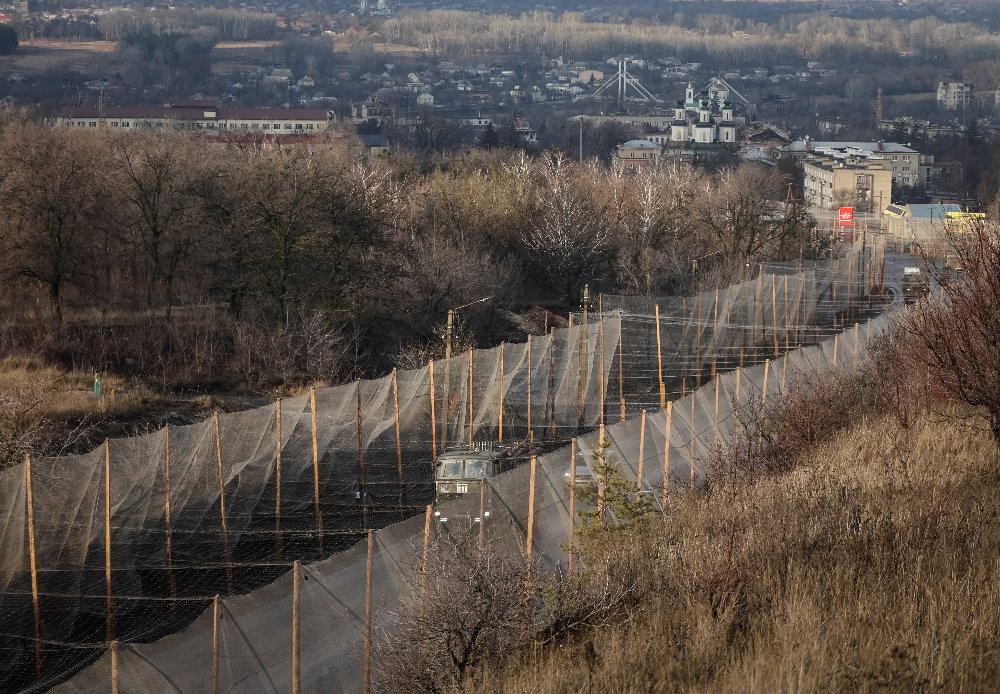
Completed anti-drone netting tunnel over an open highway. Photo courtesy of the Ministry of Defence of Ukraine / State Special Transport Service. Used for educational/informational reporting.
Though Israel's 'Iron Dome' has provided extraordinary protection against attacks from the air—recently coming at it from the north, east, and south—Israel is now also taking a page from the thrifty upcycling solutions book of Ukraine, as an increasing portion of those attacks are via drones.
Ukranians know from extensive first-hand experience that drones are the disruptive, low price weaponry of the day. But Ukranians' experience also taught them that a drone kept at even a fairly short distance from its target is dramatically less harmful. And, realizing this, they devised an upcycling solution with many winners: repurposed netting sourced from commercial waste streams and discards.
How a tunnel of netting thwarts a drone#
- Propeller snagging and tangling: First-Person View (FPV) kamikaze drones rely heavily on exposed, high-speed plastic or carbon-fiber propellers to maintain flight and maneuverability.
- The snag: when a drone tries to dive into the covered roadway to strike a vehicle, it hits the netting.
- The result: the mesh quickly wraps around the spinning rotors, instantly binding the motors, causing the drone to lose lift and crash harmlessly onto the net or the ground before reaching its target.
- Preventing contact-fuze detonation: most kamikaze drones utilize a highly sensitive impact fuze (protruding wire loops or a pressure switch at the very front of the drone) to detonate their explosive payload.
- The cushion: the tension and elasticity of suspended netting can act like a trampoline or a hammock. If a drone is flying slightly slower or catches the net just right, the mesh can decelerate or catch the body of the drone without triggering the front-facing impact wires.
- Premature detonation: even if the drone does explode upon impact with the net, the detonation happens several meters above the road surface. By forcing the blast to occur prematurely in mid-air, the destructive force and shrapnel are significantly dissipated before they can hit the logistics trucks or emergency vehicles moving underneath.
- Neutralizing fiber-optic and electronic warfare-resistant drones: signal jammers are useless against the new wire/fiber-guided drones, but the 'physical armor' of these overhead nets provides one of the few reliable defenses to protect vital corridors
The win-win: sourcing upcycled materials#
Team Ukraine quickly assessed what types of netting were optimal for different parts of the 'tunnel.' The good news was that those netting types were available in discards and waste streams.
- International commercial waste streams (Fishing Nets): a massive percentage of the heavy-duty netting comes from industrial fishing and aquaculture fleets across Europe.
- The scale: The Scottish Government recently arranged the transfer of 280 tonnes (228 massive nets) of used salmon farm nets that were sitting in storage awaiting disposal.
- The global effort: industrial fishing communities in France, Denmark, Norway, and the Netherlands have similarly diverted thousands of tons of retired commercial trawling nets.
- Why it works: for commercial fishermen, disposing of worn-out or damaged nets is incredibly expensive due to strict environmental maritime waste laws. Repurposing them for Ukraine solves a waste problem for Western ports while providing incredibly strong, free material that can snag even heavy loitering munitions traveling at 90 mph.
- Agricultural discards: in addition to maritime gear, a significant portion of the netting is sourced from the agricultural sector.
- Tulip and crop nets: in countries like the Netherlands, agricultural cooperatives have donated thousands of square meters of lightweight, UV-stabilized polyethylene nets originally used to cover tulip bulb fields and berry crops to protect them from birds.
- Why it works: while lighter than deep-sea fishing nets, this agricultural mesh is more than dense enough to catch the small plastic propellers of standard commercial quadcopters and FPV drones.
- Local domestic drives: within Ukraine, volunteer networks have stripped localized supply chains of netting. Everything from sports stadium soccer goal nets and tennis nets to cargo-vehicle tie-down mesh has been collected. Local volunteer groups take these miscellaneous repurposed nets and weave in strips of green and brown fabric to turn them into dual-purpose anti-drone and camouflage canopies.
Upcycled materials slash the build cost#
Because the raw mesh material is so heavily subsidized by international repurposed donations, the financial cost of building these "roads of life" doesn't actually go toward buying the nets. The Ukrainian government recently allocated an additional 96 million UAH (~$2.4 million USD) specifically for net corridors in the highly targeted Kherson region. The true cost of building a kilometer of this protection—which averages about 1.8 million UAH (roughly $44,000 USD)—stems almost entirely from:
- The support infrastructure: thousands of heavy steel or wooden telephone poles, tension cables, and anchoring hardware needed to suspend the nets high enough for heavy logistics trucks to pass underneath.
- Hazardous labor: the dangerous, rapid engineering work required by the State Special Transport Service to erect these massive structures directly in zones under active artillery and aerial surveillance.
By pairing free, repurposed waste from the global fishing and farming industries with local engineering, they've created a defensive tunnel system that costs a tiny fraction of a traditional air-defense missile battery.
Netting effectiveness#
When overhead netting tunnels are introduced to a sector, outside analysts and field reports suggest the dynamics shift dramatically:
- Drop in successful strikes: analysts estimate that over stretches of road protected by properly maintained, heavy-duty netting, successful drone strikes on vehicles drop by 60% to 75% compared to unprotected roads in the same sector.
- The "mission failure" rate: of the drones sent to attack a netted corridor, OSINT analysts tracking drone footage estimate that roughly 30% to 40% are completely neutralized by physical entanglement alone (propellers snagged, motors burned out, or caught in the mesh without detonating).
- The dissipation factor: another 30% of the drones do detonate, but they detonate on the net. Analysts classify these as failed or heavily mitigated strikes. Because the detonation occurs several meters above the vehicle on the suspended mesh, the vehicle underneath usually survives. The blast wave and shrapnel field are forced to expand in open air, typically resulting in only minor cosmetic damage or broken glass rather than catastrophic vehicle loss or crew casualties.
Bravo to thrifty innovation#
Best case is that Putin stops attacking sovreign nations. Until he does, the netting tunnels show the agile Ukraine will be innovating thrifty, low tech countermeasures in addition to the high-tech ones.
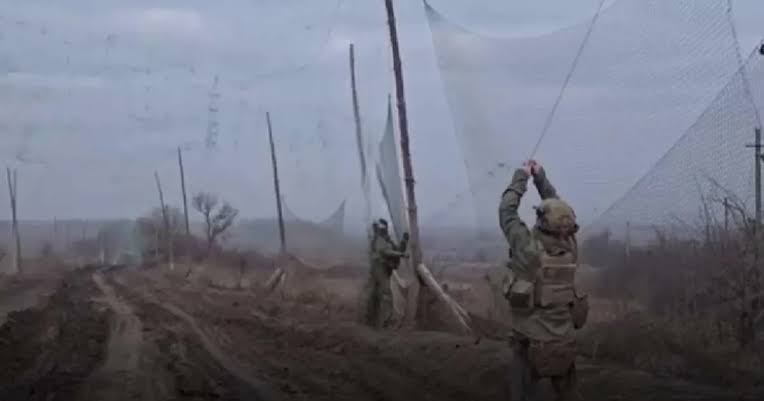
Soldiers installing anti-drone netting over a road. Photo courtesy of United24 Media. Used for educational/informational reporting.
Leave a comment
Submissions are subject to review and approval