 Kurt Abbott Bestul
The Shannon Systems Plexus: Information is the only fundamental#
From a thought-experiment collaboration with Google Gemini 3 Flash/Free-Tier.
Last tended: 2026-05-05
We think of information as something that exists inside space and time. This is normal, established, and feels so intuitively right as to not merit remark. However, for this thought experiment I am casting off "established" to make space to contemplate an alternative, compelling universe model. The model will leverage the mathematical construct known as the Plexus: an interwoven, complex, and networked structure of nodes.
Our experiment will take license in one more bold way: it will elevate Claude Shannon's "mathematical theory of communication" (now commonly just referred to as Information Theory) to a position of supremacy.
Finally, we will reject what I think of as the "container" universe notion to instead posit that "everything there is" stems simply from a Plexus of "Shannon Systems." Here, space and time are repositioned as (or if you prefer, demoted to) emergent properties of information exchange itself.
Time for a right-sized explanation of the Shannon System:
- The Shannon System (the focal point of Shannon's theory) is an information communication system composed of a source, an encoder, a channel, a decoder, and a destination. The system can be said to succeed when the source information reaches the destination fully intact.
- All "channels" are inherently noisy (a simple example is attempting to converse with a friend in a bustling, very noisy pub; the channel is the air carrying the soundwave of your voice, and the noise is the many other soundwaves "traversing" the air alongside the one of your voice. If your friend gets the information you were sending, she has done some significant decoding work without realizing it.)
- This system schematic underpins all instances of information conveyence without any exception whatsoever. Every bit of new meaning you took on in the course of living your life today happened courtesy of a Shannon System.
The introduction is completed. With that, I restate the alternate model's proposition: everything is a Plexus—a dense, interwoven, layered network—of these active Shannon Systems. It is time to explore, time to hike up Mount Plexus.
Outpost 1. The Great Loom: From "Stuff" to Stories#
We begin by seeing the Universe not as a collection of objects, but as a tapestry of conversations.
In a "Physicalist" view, the universe is a bucket of rocks, a collection of atoms. In our alternate view, "everything there is" is a Plexus—a dense web where everything is constantly "sending a message" to everything else. But the other side of "conversation" is the destination, the receiver: things only "exist" to us when we can pick up their signal. Information not received is no information at all. If a "source" can't get its information to me, then it is very literally of no consequence to me, non existent.
Outpost 2. The Nested Dolls: The Layers of Meaning#
Here we envision the "Matryoshka Doll" of Reality. The dolls—each one a Shannon System—are nested one inside the other; it's a Recursive Shannon Loop. Just as a sentence is made of words, and words of letters, and letters of ink—the "Destination" of one layer (the word) becomes the "Source" (the meaning) for the next layer (the sentence). Each layer is a "Translation Station" that takes the chaos of the layer below and turns it into a clear signal for the layer above. Meaning is created by compressing the noise of the lower layer (the raw data) into the "signal" of the higher layer (the pattern).
Outpost 3. The Infinite Library: Traversing the Geometry#
Here we imagine The Library of All Possible Books; we are using the library as our metaphor for a transformative recent breakthrough in particle physics: the Amplituhedron—a static, multi-dimensional geometry that represents all possible interactions, which in our model is the geometry of the Shannon "channels" themselves.
Our Plexus is the basis of the "Map" of every possible truth and connection that could exist in our Library of All Possible Books. We aren't creating new space; we are venturing through the rooms of the library. Here, to "discover" isn't to "make" something new—it is to finally find the right aisle and shelf in the geometry of "everything there is" (the Amplituhedron). Conversely, an unsolved "problem" is simply a book we have not yet charted our way to. (See Case Study: The Atomic Signal at the end of this article for a look at how humanity spent 2,000 years 'finding the shelf' for the atom)
Outpost 4. The Error-Correction Engine: Solvability and Progress#
We snuck in and co-opted another storied construct at the end of Outpost 3: the "everything is problem solving" framework conceived by Karl Popper and refined by David Deutsch. The right-sized introduction to this realm flows from its name:
- the universe is a layered infinity of problems, for each of which Intelligence, the most exceptional facet of the universe, is able to iteratively solve via explanatory conjecture and the tuning of those theories via error correction.
Given that intro, the metaphor of the Self-Correcting GPS will carry us forward. As our intro just explained, in the Popper-Deutsch framework, knowledge isn't just a fact; it’s a "solution." It’s the mechanism that filters the "static" out of our journey through the Plexus.
Because the recursive layering of the Plexus is inexhaustible, our GPS will always find a new "recalculating" route to higher complexity. To be more technical, we would say the plexus is inexhaustible/functionally infinite because every "solution" at Layer \(N\) creates a new "problem" (and thus new potential meaning) at Layer \(N+1\).
Outpost 5. The Ouroboros Circuit: Closing the Strange Loop#
I couldn't resist the Ouroboros allusion here—the ancient symbol of a serpent or dragon eating its own tail, representing eternity and cyclic renewal—but I will also offer a tech metaphor alternative: System Logic provides the set of rules that define how the system loop will close.
At Outpost 4 your "infinite regress" sensor's alert indicator may have started flashing: alert, the wristwatch seems to be functioning without a spring, it looks to be just gears all the way down. But the sensor has committed a "false positive": it doesn't comprehend that the Plexus's highest level of abstraction (Logical Laws) loops back to define the lowest level of substrate (Quantum Bits). The gears don't go down forever; the bottom gear is actually driven by the top gear.
The Plexus is stable because it is a Strange Loop—a self-consistent, self-actualizing circuit where the end informs the beginning (conceived and beautifully articulated in Douglas Hofstadter's books "I am a Strange Loop" and "Gödel, Escher, Bach").
Reaching the Summit: The System Integrator#
I would be surprised if you had not been pondering how you fit into the Plexus. Think of your own acquisition of knowledge as an act of Plexus "system integration." We—as Shannon Systems ourselves—are essential. We humans are the apex nodes that perform the most demanding active work of error correction.
To "know" is to "wire." Via our lives of continually solving problems, we are literally tightening the connections of the Plexus and advancing the "Beginning of Infinity" (the Popperian "cosmology" conceived by David Deutsch in his book "The Beginning of Infinity").
The View from the Summit: The Architecture of the Real#
When we have successfully hiked through the outposts, we find ourselves looking out on a reality that looks fundamentally different from the one we started in—from this height, even the 'ground' we stand on looks different. We have moved from a universe of "things" to a Plexus of Processes.
The Shannon Plexus: A Distilled Summary#
To navigate "everything there is," we need only three coordinates:
- The System: The active nodes (from quarks to consciousness) that encode, transmit, and decode signals.
- The Geometry: The static map of all possible connections (the Library/Amplituhedron) that we are constantly traversing.
- The Loop: The self-correcting, recursive cycle where information is refined into knowledge, eventually looping back to provide the very logic that allows the substrate to exist.
The Emergence of the "Container"#
Perhaps the most radical "recalculating" our GPS must do for our thought experiment is in regard to Space and Time. In the Plexus model, these are no longer the stage upon which the play occurs; they are the telemetry of the information exchange itself.
- Space is Latency: In a Shannon System, distance is effectively a measure of the noise or delay between a Source and a Destination. If two systems share high Mutual Information with zero lag, they are "here" to one another. If the channel is broken or the noise is total, they are "infinitely far apart." We don't live in a 3D box; we live in a web of varying connection speeds.
- Time is the Clock-Cycle: Time is not a flowing river; it is the sequential update of system states. It is the "ticking" of the encoder as it moves from one bit of information to the next. What we perceive as the "arrow of time" is actually the irreversible process of a Shannon System solving a problem and moving to the next abstraction layer.
The Architecture Diagram: The Recursive Stack#
Imagine a diagram not of planets in orbits, but of a vertical, shimmering stack. The nodes represent fundamental thresholds of information density—non-negotiable checkpoints in the journey from a geometric bit to a self-referential logic.
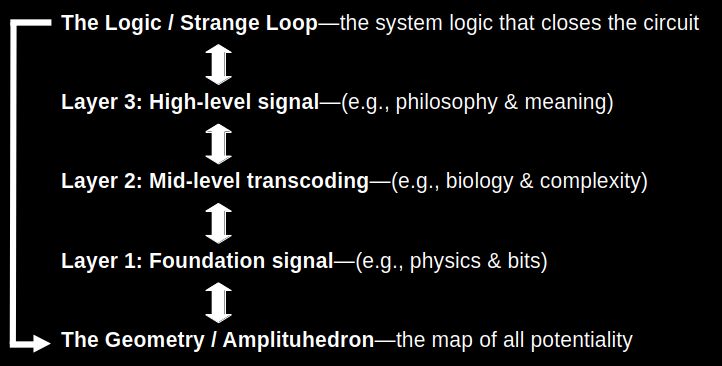 Note: while the specific labels and examples for these nodes may evolve with our understanding, the structural hierarchy of thresholds is a mechanical requirement of the system. All upward information flows reflect "emergence."
Why it Matters#
This isn't just a clever way to rearrange the furniture of reality. By viewing "everything there is" as a Plexus of Systems, we shift from being passive observers in a cold, vast vacuum to being active participants in a meaningful dialogue.
We are the ones clearing the lines, reducing the entropy, and ensuring the signal gets through. In the Plexus, the universe doesn't just "exist"—it is communicating, and we are the ones who make sure the message is heard.
Case Study: The Atomic Signal (Decoding the Micro-Plexus)#
To see the Shannon Systems Plexus in action, humanity's "relationship" with the atom is a telling place to look.
-
The Noisy Intuition (The Blurred Signal): Democritus and Dalton perceived that a "message" was being sent. They saw the output of chemistry, but the Source was obscured by the overwhelming noise of the macroscopic world. The "Channel" was open, but our "Decoder" was primitive.
-
Narrowing the Bandwidth: Throughout the 19th and 20th centuries, every scientific breakthrough—from the Cathode Ray to the Gold Foil experiment—was effectively an upgrade to our receiver. We weren't inventing the atom; we were filtering out the "static" of classical physics to hear the quantum signal beneath.
-
The Synchronized State: Today, with Quantum Field Theory and the Amplituhedron, we have achieved Phase-Lock with the atomic signal. We have identified the parity bits, corrected the errors, and integrated the "Atom" node firmly into the human plexus.
The Lesson: The atom didn't "become more real" over time. Rather, the Shannon Channel between human intelligence and the atomic layer reached a high enough Bit-Rate for the signal to become "fact."
Works referenced:#
Additional material regarding the theories and concepts referenced:#
Amplituhedron article, Wikipedia
Amplituhedron podcast on this site
Information Theory article: "Information Theory distilled" on this site
Popper-Deutsch article: "Popper-Deutsch optimism" on this site
Leave a comment
Submissions are subject to review and approval